The ‘murmuring’ of starlings, synchronized and in one direction, has taken over the skies of Italy after fleeing the cold from their home territory.
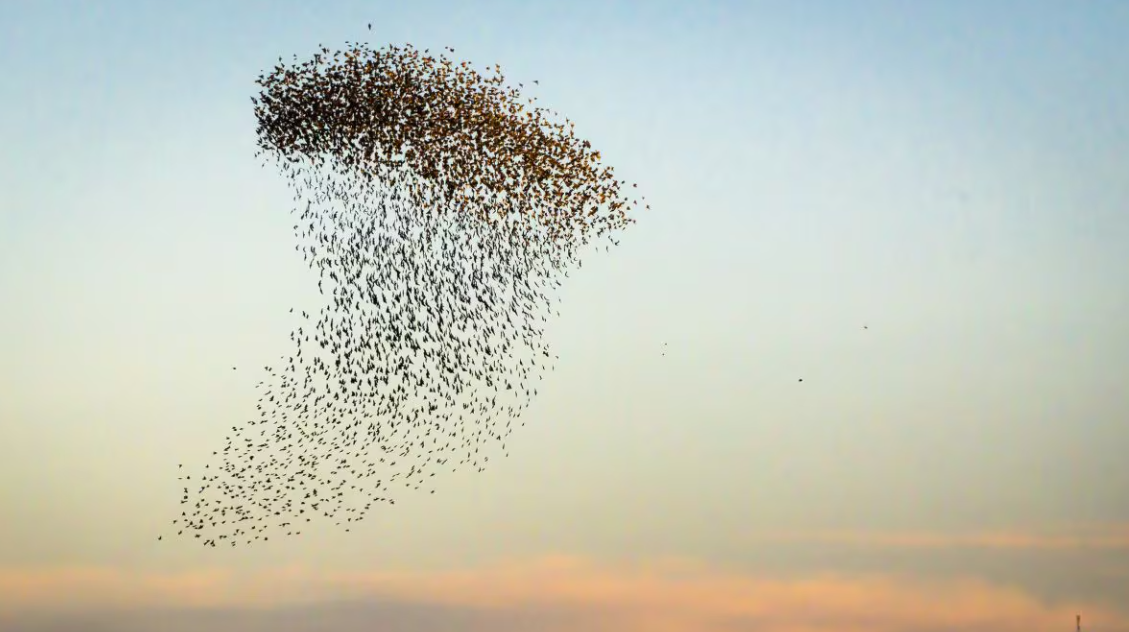
All residents and tourists visiting Rome are struck by a seasonal natural phenomenon that darkens the city’s skies before nightfall. This phenomenon is caused by a wide variety of migratory birds, known as starlings, which arrive in the Italian capital fleeing the cold of northern Europe.
These small-headed, black-plumaged birds with long tails primarily have a ritual of spreading their wings each year in cities with better climatic conditions than their native regions. For this reason, Rome is a preferred destination for these migratory birds, with more than 500,000 birds typically flying over it annually.

However, the gathering of more than 40,000 starlings, where they all follow a single direction thanks to perfect synchronization, is known as ‘murmuring’, according to the British, and they have enough ability to color the sky black with their presence, depriving of natural light all those who observe this phenomenon.
The starling flock, a ‘complex system’, according to scientists
Every year, with the arrival of colder weather, millions of these small, black-feathered birds migrate from northern Europe to Italy, seeking warmer climates. The hordes of starlings perform spectacular, perfectly coordinated aerial ballets above the imposing Roman monuments, sometimes even darkening the sky to the astonishment of passersby.
As the sun sets in the center of Rome, five people dressed in white jumpsuits position themselves under the trees with loudspeakers that emit a mix of high-pitched sounds, triggering a stampede of flocks of starlings. “I’ve never seen anything like it in my life… It’s incredible!” confesses Eva Osuna, a Spanish tourist, as she captures the birds with her mobile phone against a sky that is gradually being painted with the radiant colors of the legendary Roman sunset.
This species of passerine bird, which measures up to 20 cm, “spends the day in rural areas, where it finds food and returns to the city at night to sleep,” explains Francesca Manzia, ornithologist and local head of the Italian League for the Protection of Birds (LIPU).
Read more: Sore throat, symptom of omicron or caused by air conditioning?
These migratory birds fly in flocks as a strategy for survival and to avoid predators. This year, experts estimate that between 500,000 and one million birds have arrived, despite the challenges they face and cause.
Besides noise pollution, “starlings are a problem primarily because of their droppings, which cover avenues with mounds of feces, causing accidents and slips among pedestrians, in addition to the strong odor,” Manzia emphasizes. “But they don’t transmit diseases,” the expert points out.
To minimize the disturbance, the city council is trying to scare the birds away using a natural method: loudspeakers and flashlights used by “hunters” hidden among the cars. “We take advantage of their fear response, using their alarm calls. It’s as if they’re communicating to each other that the area is dangerous and that it’s best to stay away,” Marianna Di Santo, director of the private company Fauna Urbis, which was commissioned by the Rome city council to run the program, explained to AFP.
“ A
few years ago, they weren’t so urban,” Manzia explains. “But in the city, temperatures are higher and the lights help them orient themselves and protect themselves from predators,” she says. Some trees in the capital are used as “roosts” by starlings, and that’s why it’s common to find sidewalks, cars, and motorcycles stained with thick layers of droppings, as is the case along the Tiber River.
Some Romans don’t dare venture along the riverbanks without an umbrella. Due to the residents’ exasperation, the authorities have tried to keep them away with falcons and lasers, but the sound method is “the simplest and most effective,” says Valentina de Tommaso, an employee of Fauna Urbis.
Read more: Syria: More than 150 dead reported in fighting after prison attack
The company operates “two or three times a week,” sometimes near Termini station, an area the birds love because it’s bright and sheltered from the wind. “We play recordings of about 10 minutes, with pauses so they don’t get used to the noise,” a “disturbing” but harmless method, designed to break up the swarms and thus limit the damage they cause, she adds, dressed from head to toe in a jumpsuit adorned with reflective strips. Amidst passersby, tourists, and workers, the flocks of blackbirds flee amidst sharp, heart-rending cries, giving the scene a horror movie feel.
“Walking under clouds of starlings isn’t exactly ideal,” laments Francesco Fusco, a 55-year-old engineer, while 16-year-old student Alessio Reiti is captivated by this magnificent natural phenomenon. “They’re magnificent. I really like the shapes they create. You just can’t put diapers on nature,” he remarks with amusement.