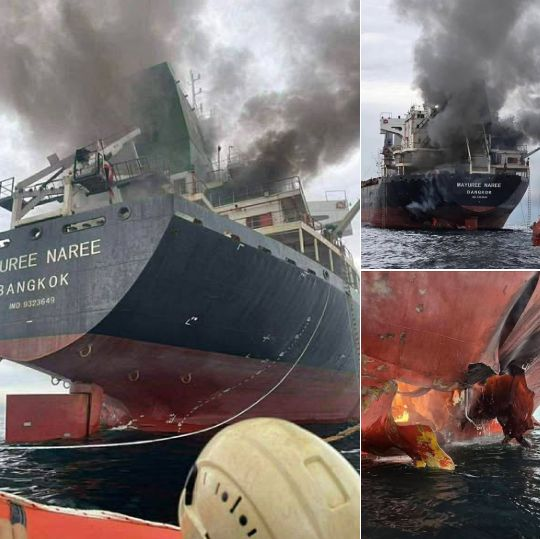
The security situation in the Middle East has become increasingly critical following attacks on commercial vessels transiting the strategic Strait of Hormuz. This incident has sounded alarm bells for governments, shipping companies, and global energy markets alike, given that the strait is a vital artery for international trade.
Context of the Incident
Iranian officials had previously issued stern warnings stating that any vessel linked to the U.S., Israel, or their allies could become a legitimate target if it transited the strait without authorization. The decision by certain cargo ships to disregard these warnings is believed to have prompted the Islamic Revolutionary Guard Corps (IRGC) to take action.
Details of the Incident
According to maritime monitoring agencies, multiple commercial vessels were struck by artillery fire or airborne projectiles. Notably, a Thai-flagged bulk carrier suffered a severe fire in its engine room, forcing the crew to evacuate part of the ship. Two other vessels—registered in Japan and the Marshall Islands—were also hit but sustained only minor damage. As of now, there have been no reports of major casualties, and authorities are actively investigating the matter.
In response to the situation, maritime associations have issued urgent advisories, urging all vessels in the area to exercise extreme caution and to report any signs of suspicious activity immediately.
Strategic Importance of the Strait of Hormuz
The Strait of Hormuz is recognized as one of the most critical maritime chokepoints on the planet. Serving as the link between the Persian Gulf and the Gulf of Oman, this route facilitates the transport of approximately 20% of the world’s crude oil. Major oil and gas exporters—such as Saudi Arabia, the UAE, Kuwait, and Iraq—rely entirely on this passage to distribute energy to global markets.
Consequently, even the slightest disruption could destabilize global trade, forcing shipping companies to halt operations, causing insurance costs to skyrocket, and directly driving up oil prices.
Implications for the transport and energy sectors
Immediately following the attack, numerous cargo vessels were forced to slow down, anchor in place, or alter their courses. Insurance companies quickly designated the area as high-risk, leading to increased premiums for ships traversing the Gulf. Governments worldwide also urged their commercial fleets to exercise extreme caution, or even temporarily avoid the strait until the situation stabilizes.
Escalating military conflict
This incident occurred amidst signs of escalating military operations in the region. Previously, the US military and its allies had conducted airstrikes targeting Iranian military assets, including warships. In retaliation, Iran launched waves of missiles and drones at military targets while also posing a direct threat to civilian shipping lanes. Analysts fear that targeting commercial vessels could cause the conflict to spread further.
Concerns regarding the global economy
Instability in the Strait of Hormuz is placing immense pressure on global energy markets. If the attacks persist or a blockade is enforced, crude oil supplies could be choked off, driving up global fuel prices. Asian and European nations—economies heavily reliant on oil from the Gulf—are closely monitoring developments and beginning to consider emergency energy contingency plans.
Calls to De-escalate
Leaders and international organizations are collectively urging all parties to exercise restraint, ensure the safety of civilian vessels, and de-escalate tensions. Freedom of navigation in international waters is a cornerstone of global trade, and any attack on commercial vessels is viewed as a serious threat to collective security.
An Uncertain Future
While investigations are ongoing, the waters surrounding the Strait of Hormuz remain one of the world’s most volatile “powder kegs.” With military forces on high alert and global financial markets watching with bated breath, the coming days will determine whether this crisis intensifies or begins to subside.