Breast cancer doesn’t appear overnight as a noisy emergency. In the vast majority of cases, it develops slowly, leaving subtle clues that we often mistake for hormonal changes, stress, or simply the aging process. However, in the fight against this disease, time is our best ally. ⏳💖
Learning to “read” your breasts isn’t an act of fear, but an act of self-love and prevention . Here we explain which symptoms require immediate medical attention and how you can take care of your health starting today.
🛑 1. Lumps or masses: The most well-known sign
This is the ultimate warning sign, but there are details you should know. A suspicious lump isn’t always a perfect “ball.” 🧐
- Texture: It usually feels like a hard, fixed mass with irregular edges .
- Pain: The most deceptive thing is that, in their initial stages, these lumps usually don’t hurt . Many people make the mistake of thinking, “Since it doesn’t hurt, it can’t be anything serious .” Beware! That’s precisely the reason to have it checked. ⚠️
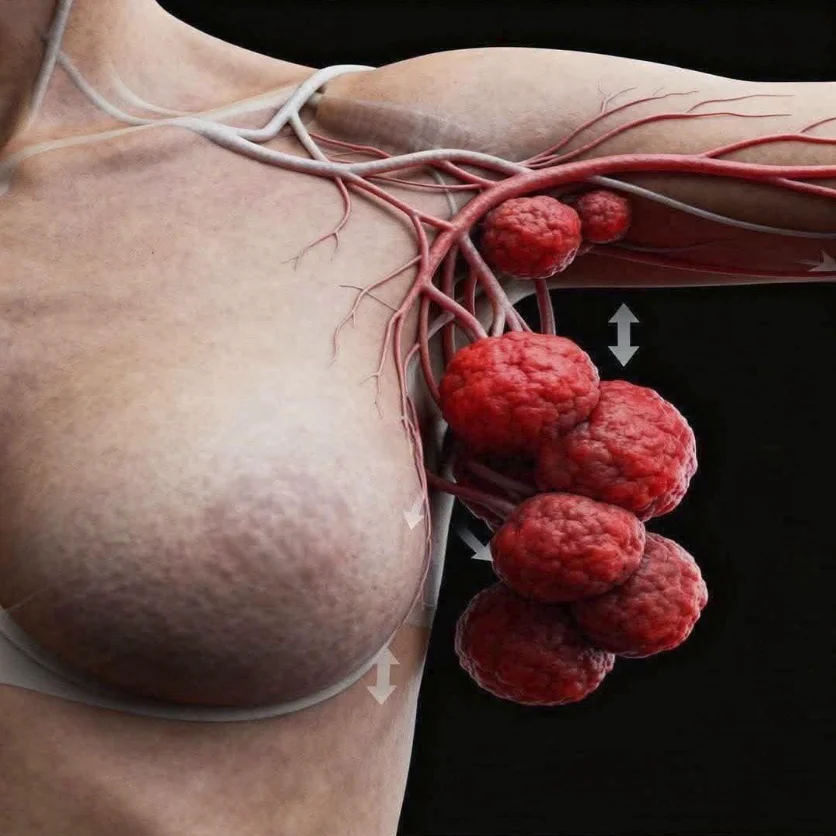
- Location: Don’t just look in the center of the breast; remember to also check the armpit area , as breast tissue extends there and the lymph nodes can become swollen in the presence of foreign cells. 🔍
🍊 2. Changes in the appearance of the skin
Sometimes, the symptom isn’t “inside,” but on the surface. The skin of the breast can give us very clear visual warnings:
- Orange peel skin: If you notice your pores looking larger and your skin developing a rough texture (similar to orange peel), it’s a major warning sign. 🍊
- Dimples or indentations: When you raise your arms in front of the mirror, look for areas that appear to be “sucked” inwards. This may indicate that an internal mass is pulling the tissue towards the center.
- Persistent redness: If an area of your breast appears red, hot, or swollen and doesn’t improve over time, don’t assume it’s just an allergy or insect bite. 🌡️🚫
💧 3. Strange changes in the nipple
The nipple is an extremely sensitive area and any change in its shape or behavior should be evaluated:
- Nipple inversion: If your nipple has always been outward-pointing and suddenly starts to retract or invert , consult your doctor. ⬇️
- Unusual discharge: Unless you’re breastfeeding, any fluid coming from your nipple (whether clear, milky, or tinged with blood) is a sign that something is happening in your milk ducts. 🛑🩸
- Scaling or crusting: The presence of dry, scaly, or persistently itchy skin in the areola area may be a symptom of specific conditions that require attention.
⚡ 4. Localized and persistent pain
It’s normal to feel tenderness or pain in both breasts before your period (mastalgia). However, the pain you should be concerned about is sharp, localized pain that doesn’t go away after your period ends. While cancer doesn’t always cause pain, unusual pain is often your body’s way of asking for a checkup. 📈🩹
🧠 Why do many people delay diagnosis?
The main enemy of early detection is the normalization of symptoms .
- “It’s just a change due to age . “
- “It’s probably a cyst caused by coffee or stress . “
- “I don’t go to the doctor because I’m afraid of what they’ll tell me . “
The truth is that fear doesn’t make the problem disappear, but information does provide solutions. Most detected lumps turn out to be benign (cysts or fibroadenomas), but only a professional with a mammogram or ultrasound can confirm this. 🩺🔬
🛠️ Your action plan: The monthly self-examination guide
You don’t need medical equipment to start taking care of yourself. The monthly self-exam (performed 3 to 5 days after your period ends) is your first line of defense: ✅
- In front of the mirror: Observe your breasts with your arms at your sides, then with your hands on your hips, and finally with your arms raised. Look for asymmetries, lumps, or changes in the skin. 🪞
- Standing breast self-exam: With one hand behind your head, use the three middle fingers of your other hand to gently press in circular motions, covering the entire breast and armpit. 🖐️🌀
- Lying down palpation: Repeat the process while lying down; this allows the breast tissue to be distributed more evenly and makes it easier to detect abnormalities.
- Nipple pressure: Gently squeeze to check for any discharge.
🌟 Conclusion: Early detection saves lives
Breast cancer is a reality, but it doesn’t have to be a death sentence. The key is knowing your body so well that any small change is immediately noticeable. 🛡️💖
Don’t wait until you’re in pain to get your annual mammogram if you’re over 40, or earlier if you have a family history. Listening to your body, getting regular checkups, and maintaining a healthy lifestyle are the best tools you have to protect your future. 🚀🌸✨
Important notice: This content is for informational and educational purposes only. It does not replace professional medical consultation, diagnosis, or specialized treatment. If you notice any changes, lumps, or persistent discomfort in your breasts, consult a gynecologist or breast specialist immediately. 🩺🛡️