PART 1
“If you marry him, Dad lives. If not, we’ll lose him before the month is out.”
Lucía stood motionless before the mirror in the beauty salon, her white dress cinched at the waist, her eyes filled with a sadness that even makeup couldn’t conceal. Outside, on the main street of San Miguel del Río, the flower-adorned SUVs were already waiting, the guests with their cell phones at the ready, and half the town prepared to watch the quietest librarian in the municipality marry Esteban Montero, owner of two hotels, three restaurants, and arrogance that couldn’t fit in any church.
“Just look at that dress,” murmured Maribel, her best friend, feigning delight. “It probably cost more than my house. Lots of girls would love to get married like that.”
Lucía pressed her lips together. She didn’t want to get married like this. She didn’t want to marry Esteban.
A year earlier, her fiancé, Diego Salvatierra, had died during an expedition in the mountains. He was a mountaineer, cheerful, noble, one of those men who greeted the street sweeper the same as the mayor. Lucía still remembered his last call: “I’ll be back and we’ll start planning the wedding, I promise.” He never returned.
They said it was an accident. That the safety rope broke. That Diego fell before his companions could do anything. But ever since, Lucía has carried a horrible feeling in her chest. Diego was careful with his equipment. Obsessive, even. He checked every hook, every rope, every knot, as if his life and everyone else’s depended on it. Because they did.
Then came his father’s illness.
Don Ramón, a lifelong electrician, began experiencing pains that doctors mistook for gastritis. By the time they finally arrived at the correct diagnosis, surgery was urgent. The operation cost a fortune. Lucía went to ask for loans, sold her mother’s jewelry, offered to work extra hours at the library, but nothing was enough.
Esteban appeared just when she was most desperate.
“I can pay for everything,” he told her one afternoon, leaning against his black SUV in front of the bank. “The surgery, the medications, whatever it takes. But you’ve known how I feel about you since high school.”
Lucía felt disgust, anger, and shame. Esteban had always hated Diego. At school, he bullied him because everyone liked Diego and he could barely stand him. Later, when Diego and Lucía became a couple, that envy turned into something dark.
But his father was dying.
“Don’t ask me for love,” she said, her voice breaking.
—I’m not asking you right now— Esteban replied. —As long as you agree to be my wife, the rest will fall into place.
And so, amidst murmurs from the town, pitying glances, and cruel gossip, Lucía ended up dressed as a bride, walking towards the Civil Registry on the arm of a man she could never love.
“Don’t make that face,” Esteban whispered to her as they got out of the white limousine. “Everyone’s watching us today.”
—That’s precisely why—she replied.
The registrar left in a hurry.
—Oh, sorry, Mr. Montero, there was a misunderstanding. The Sosa family is going through first. Their ceremony isn’t for another half hour.
Lucía felt an absurd relief. Half an hour wasn’t freedom, but at least it was a break.
Esteban forced a smile in front of the guests.
—A slight delay, nothing serious. We’ll wait.
Lucía asked to go to the limousine to get her shawl. The dress was beautiful, but the February chill bit her arms. Esteban accompanied her, still pretending to be chivalrous.
When they reached the vehicle, everyone remained silent.
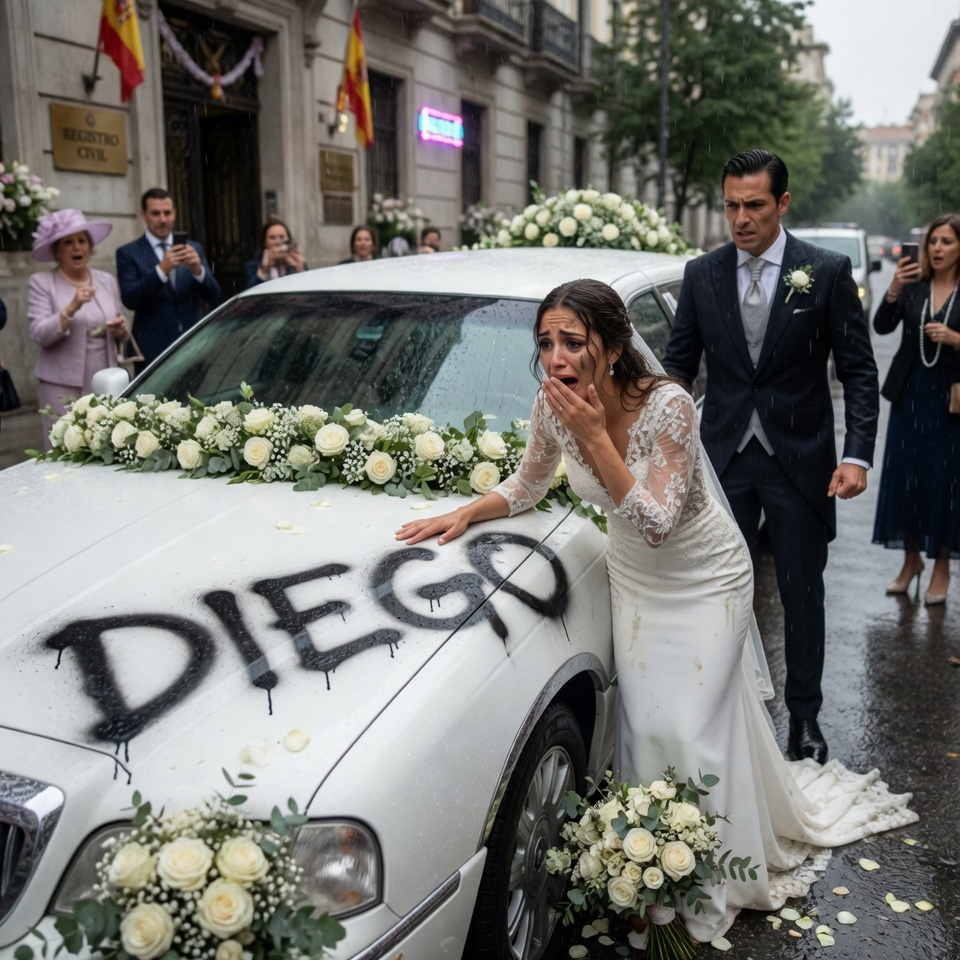
On the white chest, written in black charcoal in enormous letters, was a single word:
DIEGO.
Lucía felt like the world was slipping away from her. The guests began to murmur. Maribel covered her mouth. Esteban turned pale.
“Who did this?” he shouted, looking around.
But Lucía heard nothing. She only saw that name. The name of the man she had loved. The name of the dead man she was betraying.
Suddenly she remembered Esteban’s rivalry with Diego. She remembered his hateful stares, his venomous comments, his smile when she agreed to marry him.
And something inside her broke.
Lucía picked up the bouquet and threw it at Esteban’s face.
—I won’t marry you!
The guests screamed. Some pulled out their cell phones. Esteban tried to take her arm, but she gathered up her dress and ran down the street, barefoot in spirit, broken with fear, the name Diego burning in her chest.
Nobody could believe what had just happened… and even less what was about to be discovered.
PART 2
Lucía ran until her heels dug in like knives. At a corner, she kicked off her shoes and threw them in a trash can. People stared at her as if she were a ghost: a bride crying, her dress stained with street dust and her makeup running down her cheeks.
He took a taxi, barely able to speak.
“Did you run away from the wedding, honey?” the driver asked, looking at her in the rearview mirror.
—Just drive, please.
When he got home, his mother opened the door and let out a scream.
—Lucía! What happened? Where are your shoes?
“Diego stopped me, Mom,” she said, trembling. “Somehow… Diego stopped me.”
Doña Elena tried to hug her, but Lucía broke free. She ran to her father’s room and collapsed next to the bed.
—Forgive me, Dad. I couldn’t. I couldn’t marry him.
Don Ramón, pale and thin, stroked her hair.
—Daughter, I prefer to die in peace than to see you buried alive.
Meanwhile, Esteban furiously reviewed the security camera footage from the cars parked in front of the Registry. One camera captured a young man emerging from the old municipal boiler room, his clothes stained with soot. He approached the limousine, wrote the name on it, and left as if nothing had happened.
“I’m going to find you,” Esteban muttered. “And you’re going to learn not to mess with me.”
The young man’s name was Mateo Cárdenas.
He was twenty-three years old and worked as a boiler room assistant, servicing several offices downtown. Few knew that just months before, he had lived on the streets. He grew up in a children’s home in Guadalajara, leaving with a basic trade and a strong desire to work, but life dealt him blows: he lost his job, lost his documents, fell in with the wrong crowd, and ended up sleeping wherever he could.
One night, in the mountains, seeking refuge near some abandoned cabins, he found a seriously injured boy at the foot of a ravine. It was Diego.
“Help…” the climber managed to say. “In my jacket… there’s a letter… for Lucia… tell her I love her.”
Mateo wanted to run to the village to ask for help, but as he crossed the dirt road, a pickup truck hit him and knocked him unconscious. He woke up months later in a hospital, with no one knowing who he was. When he finally recovered his belongings, he found the letter intact. There was also a photo: Diego embracing a young woman with sad eyes and a sweet smile.
Matthew promised to deliver that message.
But when he went to look for her, no one answered the door. Then he got a job, a borrowed room, and a new opportunity. Until he overheard two women gossiping at the market:
—Lucía, the one from the library, is getting married on Saturday to Esteban Montero.
Mateo felt rage. He didn’t know Lucía, but he had seen Diego die with his name on his lips. So, when he saw her enter the Registry on the arm of another man, he did the only thing he could think of: he wrote “DIEGO” on the limousine.
The next day he went to Lucia’s house.
Doña Elena opened the door suspiciously, but Lucía appeared behind her.
—Let it go, Mom.
Mateo sat in the living room with a cup of coffee that he didn’t touch. He told her everything: the mountain range, Diego’s injury, the letter, the accident he himself had suffered, the months in a coma. Then he took a crumpled envelope and a photograph from his jacket.
Lucía recognized Diego’s handwriting before opening it.
“My love: if you are reading this, perhaps I haven’t returned. I don’t want you to be tied to my memory, but I also don’t want you to forget your worth. No one has the right to buy you, not even out of necessity. If you ever have doubts, remember this: I loved you freely, not by obligation.”
Lucía cried like she hadn’t cried since the funeral.
“He knew,” she whispered. “Diego knew I could get lost trying to save my dad.”
Mateo lowered his gaze.
—I shouldn’t have judged her. I thought I had forgotten about it.
—I didn’t forget. I was sacrificing myself.
From that moment on, something changed. Lucía sought out Mateo several times to thank him, to talk, to understand how a stranger had kept a promise when so many acquaintances had turned their backs on her.
But Esteban was looking for it too.
One night, three men intercepted Mateo as he was leaving the room where he lived.
“Are you the brave one who ruined the boss’s wedding?” one of them said.
They didn’t wait for a response. They beat him until he was lying next to a vacant lot, out in the cold. One of them tried to finish him off with a rock, but another stopped him.
—Leave it. With this frost, it won’t get light.
Mateo saw the cloudy sky and thought that perhaps life was once again going to charge him too dearly.
He didn’t die because an elderly woman named Doña Mercedes went out to walk her dog, Capitán, and found him before the cold finished its work. She had been a nurse for thirty years. She lifted him as best she could into a wheelbarrow, took him to her house, and nursed him back to health with the patience of someone who knows how to save lives without asking permission.
When Mateo woke up, he couldn’t move his legs properly.
“Relax,” she told him. “You’re alive, boy. That’s already a victory.”
Days later, Lucia received a call from the boiler room manager.
—Miss, we know where Mateo is. He was badly beaten. A woman has him at her house.
Lucía felt an icy chill on her back. She understood immediately that it hadn’t been just any robbery.
And as I was leaving to see him, Esteban appeared at the door of his house.
“We can still fix this,” he said. “Your dad still needs that operation.”
Lucia looked at him with a calmness that enraged him more than any scream.
—I’d rather sell my soul piece by piece than give it to you.
Esteban smiled slightly.
—Is all this because of the dead man or the charcoal burner?
Lucía didn’t answer. But in that silence, Esteban understood that he was losing something that had never been his.
And just when he thought Mateo was finished, the truth began to emerge where no one expected it.
PART 3
At Doña Mercedes’s house, Mateo learned to walk again, using a cane for support. The old woman cared for him as if he were her grandson, and he, who had never had a family, began to feel something akin to a home.
Lucía arrived one morning with sweet bread and coffee. When she saw him sitting by the window, with bruises still visible, she felt a lump in her throat.
“It was Esteban, wasn’t it?” she asked.
Mateo refused to answer.
—I have no proof.
—But I do have a memory—Lucía said—. And I know how he acts when someone crosses him.
Doña Mercedes, who was listening from the kitchen, let out a sigh.
—Men who believe that everything can be bought are the most dangerous, daughter.
That afternoon, the dog Capitán approached Mateo and began licking his hand. As Mateo petted him, he noticed something on the collar: a nearly faded phone number engraved on it. Doña Mercedes had never seen it before.
“We have to call,” said Mateo.
The old woman grew sad. Captain had been her companion for months.
—If it has an owner, it deserves to know that it is alive.
They called. Half an hour later, a sleek SUV arrived. A young man in a simple suit got out, and when he saw Mateo, he froze.
He was identical to him.
“It can’t be,” murmured the newcomer.
His name was Santiago Aranda, the son of a businessman from Morelia. The family had lost a twin baby twenty-three years earlier. They were told at the time that a nurse had taken him from the hospital at the behest of a woman who wanted revenge on the children’s father. The baby was never found.
When the Aranda family saw Mateo, they didn’t need much proof to feel the truth, although later the tests came and confirmed it: Mateo was Alejandro Aranda, the stolen son.
For Lucía, it was like seeing justice walk through a door no one had knocked on. Mateo not only recovered a family, but also a surname, a history, and the right to stop merely surviving.
“I don’t want them to think I’m here for money,” he said, overwhelmed.
Don Ernesto Aranda hugged him with teary eyes.
—Son, you didn’t come. We found you late.
Santiago, her brother, used his connections to help Don Ramón. They arranged an evaluation with specialists in Guadalajara, and the operation was performed before it was too late. Lucía wept silently when the doctor came out and said:
—The surgery was a success.
Doña Elena knelt in the hospital corridor, giving thanks. Don Ramón, days later, took Mateo’s hand.
—You saved my daughter from a sad marriage and me from an illness. I don’t know how to repay that.
“It’s not paid for,” Mateo replied. “It’s appreciated by living well.”
Esteban found out everything and lost his temper. He had imagined Lucía would return crawling back from her father’s operation. Instead, he saw her stronger, freer, and getting closer to Mateo.
One night, drunk, he left a bar driving his pickup truck. He was yelling that nobody was taking what was his. On the highway, he crashed into a cargo truck.
He survived, but arrived at the hospital delirious from the anesthesia and alcohol. A nurse left her cell phone recorder on when she heard him talking.
“I ordered Diego’s rope to be cut,” Esteban stammered. “And I also ordered that filthy bastard to be beaten… but he couldn’t even die.”
The nurse called the police. Esteban woke up handcuffed to the bed.
“That’s not fair!” he shouted. “I was high!”
“What’s unacceptable,” said an officer, “is killing one man and trying to kill another because a woman didn’t want you to.”
The investigation confirmed the worst. One of Esteban’s former employees confessed to receiving money to tamper with Diego’s equipment before the expedition. The men who attacked Mateo also talked in exchange for reduced sentences. The entire town, which had previously judged Lucía for running away from her wedding, now lowered their gaze as she passed by.
Months later, Lucía entered the Civil Registry again. This time she wasn’t trembling with fear. She wore a simple dress, her hair was loose, and her eyes were full of peace. Mateo was waiting for her in a blue suit with a nervous smile.
Maribel, holding the bouquet, whispered to him:
—Now you really do look like a girlfriend.
Lucia smiled.
—Because now I am choosing.
Among the guests were Don Ramón, now recovered; Doña Elena, crying with emotion; Don Ernesto and Santiago Aranda; the boiler room foreman who gave Mateo a job; and Doña Mercedes, with a restless puppy that the Aranda family gave her so that she wouldn’t be alone when Capitán returned to his owners.
When Lucía and Mateo were married, they were showered with rice and bougainvillea petals. No one spoke of money, surnames, or appearances. That day everyone understood that love doesn’t rescue when it chains, but when it restores freedom.
Later, Mateo began studying engineering and working at his father’s company. Lucía left the library to coordinate a municipal reading program and support for young people without families. She never forgot Diego. Nor did she let him fade into the background. She cherished him like a light that helped guide her path.
One afternoon, while they were walking through the square, Lucia placed her hand on her barely rounded belly.
—Do you think Diego would be at peace?
Matthew looked at the sky.
—I think he just wanted to see you free.
Lucía took a deep breath. She had lost, she had cried, she had been judged, bought, persecuted, and almost destroyed by a man’s ambition. But in the end, the truth found a way to speak: in a letter, in a word written with charcoal, in a lost dog, in a found brother, and in a confession no one expected.
Because sometimes justice takes so long that it seems to forget about you, but when it arrives, it not only settles scores: it also returns what life should never have taken away.