The Architecture of a Crumb
Chapter 1: The Geometry of Cold
The alleyway behind the Sterling Spire was a masterclass in urban neglect. It smelled of rotting cardboard, damp concrete, and the sharp, metallic tang of impending frost. The wind howling through the narrow corridor didn’t just blow; it hunted, slicing through my threadbare wool coat with surgical precision.
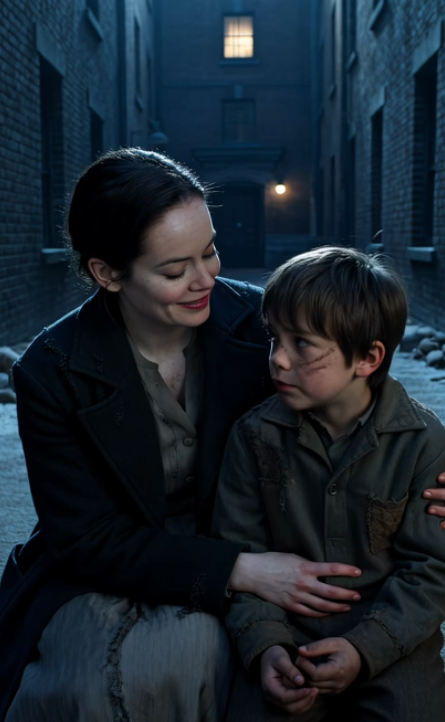
I was Clara Vance, once the youngest lead structural engineer in the city’s history. Tonight, I was merely another shadow pressed against the freezing brick, trying to survive the night.
Beside me, huddled beneath a filthy, discarded moving blanket, was Leo. He was seven years old, a casualty of the foster system’s overflowing cracks, and my sole companion in this concrete purgatory.
My trembling fingers held a single, stale heel of sourdough bread. I had traded my last pair of decent gloves for it three hours ago. I handed it to Leo.
I watched the child eat like I was memorizing every single bite.
Slowly. Carefully. He chewed with a deliberate, agonizing reverence, as if afraid even the bread might vanish into thin air if he blinked. The hollows of his cheeks cast deep, bruising shadows in the dim amber light of a distant streetlamp. My stomach violently cramped, a jagged, twisting pain that radiated up to my collarbone. I hadn’t eaten in two days.
“Eat it all,” I whispered, forcing a counterfeit, fragile smile that cracked my chapped lips. “I’m not hungry.”
It was the oldest lie in the history of the world, spoken by every mother, guardian, and protector since the dawn of time.
Leo paused. His small jaw stopped moving. He looked at me, his dark eyes unnervingly perceptive, cutting straight through the miserable facade I was attempting to uphold.
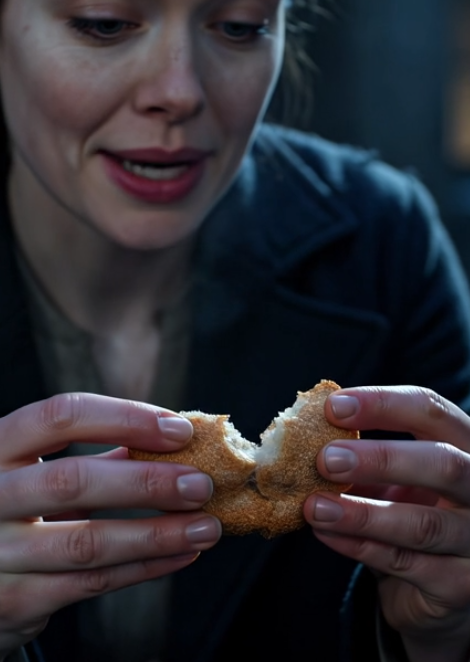
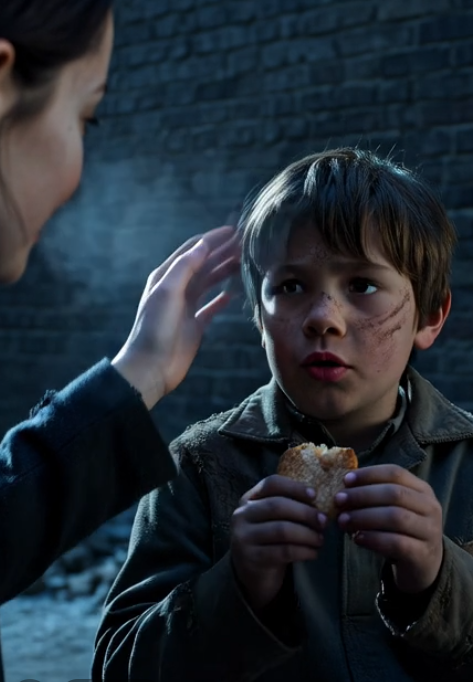
Then, without uttering a single syllable, his small, dirt-smudged hands gripped the remaining crust. With a soft, tearing sound, he broke the meager piece in half again. He extended his arm, holding the smaller fragment out toward me.
My breath caught in my throat, snagging on a sudden, razor-sharp lump of emotion.
“What are you doing?” I asked softly, my voice barely a rasp against the wind.
“For you,” Leo said.
Just two words. Simple. Utterly, devastatingly honest.
I tried to refuse. My instincts as his protector flared, and I shook my head immediately, pushing my hands deep into my empty pockets. “No, no—Leo, this is yours. You need it to stay warm.”
But the child didn’t move his hand. He just waited. His arm remained outstretched, unwavering, an offering of absolute grace in a world that had shown us none.
The silence between us swelled, feeling infinitely heavier than the freezing air pressing down on our shoulders. It was a standoff of love and desperation.
Finally, my resolve shattered into a thousand jagged pieces. A hot, unbidden tear tracked down my frozen cheek. My trembling fingers reached out, closing gently around the rough, stale crust.
For a long, suspended moment, neither of us took a bite. We just held the bread. Like it was something holy. Something sacred.
Somewhere above the lip of the alley, a distant police siren wailed, painting the low-hanging clouds with flashes of frantic red and blue. Somewhere deeper in the sprawling metropolis, life kept rushing forward without us. Billionaires dined on wagyu; politicians toasted to new developments.
But down here—pressed against broken, graffiti-scarred walls and forgotten pavement—time slowed down just enough for two people who possessed absolutely nothing, to share something that felt like everything.
I leaned the back of my head against the freezing concrete, closing my eyes, savoring the dry, bitter taste of the sourdough.
“This is still the best thing I’ve had in days,” I admitted quietly, the confession hanging in the frozen air.
Leo looked at me. Then he nodded, a slow, solemn motion, as if he understood the exact, profound weight of what I meant. In that dark, forgotten corner of the city, the warmth didn’t emanate from the calories of the food. It radiated from the sheer, undeniable reality of not being alone.
Suddenly, the heavy steel door of the service entrance thirty feet away violently banged open.
Two men in dark, tactical security uniforms stepped into the alley, sweeping heavy-duty flashlights across the dumpsters. I recognized the insignia on their shoulders instantly: Vanguard Conglomerate. My former employer.
“Sweep the alley,” the taller guard barked into a shoulder radio. “Mr. Sterling wants the perimeter completely sanitized before the gala tomorrow. Clear out the trash.”
I grabbed Leo’s hand, yanking him into the shadows, realizing with a spike of pure terror that the monsters who had destroyed my life were no longer content to just let me starve.
Chapter 2: The Architecture of Betrayal
“Move, Leo. Quietly,” I breathed, my heart hammering a frantic, erratic rhythm against my ribs.
We pressed ourselves flat against the wet brick, inching backward toward the chain-link fence at the alley’s dead end. The beams of the flashlights sliced through the darkness, illuminating the swirling snowflakes.
Marcus Sterling, the CEO of Vanguard Conglomerate, was a man whose ambition was only eclipsed by his absolute lack of a moral compass. Three years ago, I was his golden child. I had designed the Sterling Spire—the massive, ninety-story glass monolith towering directly above us. It was meant to be the crown jewel of the city’s skyline.
But during the final phase of construction, I discovered a fatal flaw.
To cut costs and accelerate the timeline, Marcus had secretly substituted the high-tensile steel core supports with a cheaper, imported, substandard alloy. I ran the stress tests. The mathematics were apocalyptic. In the event of a severe, sustained windstorm—a regular occurrence in this coastal city—the harmonic resonance would shatter the core. The Spire wouldn’t just sway; it would snap. Thousands of people would die.
I took the data to Marcus. I demanded we halt construction.
Instead, he locked me out of the mainframe. Within forty-eight hours, Vanguard’s legal team had framed me for corporate espionage and massive financial embezzlement. They froze my accounts, discredited my engineering license, and fed me to a corrupt judicial system. I barely avoided prison, but I was ruined. Exiled to the streets, forced to watch the Spire climb higher into the clouds, a glittering tomb waiting for a storm.
“Hey! You there! Stop!”
The beam of a flashlight hit us dead center. The taller guard unclipped a heavy baton from his belt, breaking into a heavy jog.
“Run!” I shoved Leo toward the narrow gap in the chain-link fence.
He scrambled through the opening like a frightened rabbit, tearing his jacket on the rusted wire. I threw myself after him, ignoring the sharp bite of metal slicing through the shoulder of my coat. We tumbled into the adjacent service street, our boots slipping on the slick, black ice.
We didn’t stop running until our lungs burned with the taste of copper and the shouts of the guards faded into the ambient roar of the city traffic.
We collapsed under the awning of an abandoned laundromat. I pulled Leo into my chest, trying to shield his shivering frame from the wind.
“I’m sorry,” Leo gasped, his small hands clutching a filthy canvas backpack to his chest. “I dropped the blanket.”
“It’s okay,” I soothed, smoothing his tangled hair. “We’re safe.”
“I… I tripped,” he sniffled, unzipping the canvas bag. “I tried to catch myself. I ripped the lining of your old jacket.”
He pulled out the heavy, waterproof trench coat I used as a ground tarp. The interior silk lining had been violently torn during our escape.
But as I looked down at the torn fabric, the blood in my veins turned to liquid nitrogen.
Hidden deep inside the lining, stitched into a secret pocket I had entirely forgotten about in my trauma-induced haze three years ago, was a small, rectangular piece of black plastic.
A heavy-duty encrypted flash drive.
I reached out with trembling fingers, pulling the drive from the ripped silk.
The master backup. The original stress tests. The unedited metallurgical reports proving Marcus Sterling ordered the substandard steel.
I had hidden it there the night Vanguard raided my apartment. The night my life ended. I had been so focused on surviving the cold, finding the next meal, keeping Leo alive, that my brain had buried the memory.
I looked up at the towering silhouette of the Sterling Spire. Tomorrow night was the grand opening gala. Marcus was hosting the mayor, the governor, and the city’s elite on the eightieth-floor observation deck.
I gripped the flash drive so hard the plastic bit into my palm. I wasn’t just a vagrant sharing a crust of bread anymore.
I held the detonator to Marcus Sterling’s empire, and I knew exactly where to plug it in.
Chapter 3: The Ghost in the Machine
“We need a terminal,” I muttered, pacing the damp floor of the abandoned laundromat.
Leo watched me, sensing the tectonic shift in my demeanor. The broken, exhausted woman who had offered him the last piece of bread was gone. The structural engineer had returned.
“What is that?” Leo asked, pointing at the drive.
“It’s a shield, Leo,” I replied, a dangerous, electric energy flooding my exhausted muscles. “But I need someone to help me wield it.”
There was only one person in this city who possessed the technical skill to bypass Vanguard’s firewalls and who hated Marcus Sterling almost as much as I did.
David Aris.
David had been the lead systems architect for the Spire. He was fired six months before I was, cast aside when he questioned Marcus’s aggressive deadlines. Last I heard, he was running a black-market server farm out of a derelict subway station in the Cauldron District.
It took us two hours of navigating the underground service tunnels to reach him. The Cauldron District smelled of ozone, burnt wire, and subterranean dampness.
I pounded on a heavy, rust-eaten steel door.
A security camera whirred above us, its red lens focusing on my dirt-streaked face. A moment later, a series of heavy deadbolts retracted with a mechanical clatter.
The door swung open. David stood there, illuminated by the ghostly blue glow of a dozen high-powered monitors. He looked older, his face covered in a thick beard, his eyes ringed with the deep, purple exhaustion of a man who rarely saw the sun.
He stared at me, his jaw dropping. “Clara? Jesus Christ… they said you skipped the state. I thought you were dead.”
“I was,” I rasped, stepping into the warmth of the server room, pulling Leo in behind me. “I need a resurrection.”
I tossed the black flash drive onto his cluttered desk.
David’s eyes widened. He recognized the Vanguard encryption casing immediately. “Where did you get this?”
“It’s the original metallurgical data, David. The stress tests. The emails from Marcus ordering the switch to the Type-4 alloy.”
David didn’t ask another question. He grabbed the drive, jammed it into a heavily modified terminal, and let his fingers fly across the mechanical keyboard. Lines of dense, encrypted code cascaded down the primary monitor.
“Vanguard upgraded their encryption,” David muttered, his eyes darting across the screen. “But Marcus is arrogant. He uses the same baseline architecture for all his shell companies.”
Ten agonizing minutes passed. Leo sat quietly on a milk crate, eating a protein bar David had tossed him.
Suddenly, the screen flashed green. A massive blueprint of the Sterling Spire materialized, covered in terrifying red warning markers around the central core.
“My God,” David whispered, leaning closer to the monitor. He pulled up the weather forecast on a secondary screen. “Clara… there’s a coastal front moving in tomorrow night. Sustained winds projected at eighty miles per hour.”
“The harmonic resonance,” I said, a cold dread washing over me.
“The core won’t just fracture,” David confirmed, his face pale, horrified by the math. “It will shear completely at the sixtieth floor. The top third of the building will collapse.”
“And Marcus is hosting the opening gala on the eightieth floor tomorrow night,” I said, my voice dropping to a lethal whisper. “He doesn’t realize the storm is coming. He thinks the building can handle it.”
“We have to go to the police,” David said, reaching for his phone.
I slammed my hand down on the desk. “Vanguard owns the police, David! They’ll confiscate the drive, bury the evidence, and the gala will proceed. Marcus will let those people die, claim it was an unforeseeable act of God, and collect a billion-dollar insurance payout.”
David looked at me, realizing the absolute, horrific truth of my words. “So, what do we do?”
“Tomorrow night, Marcus is unveiling the Spire via a live, city-wide broadcast from the main AV control room on the ground floor,” I stated, the blueprint of the building burning brightly in my mind. “I designed that control room. I know the blind spots in the security grid.”
I looked down at Leo, who was watching me with absolute trust.
“We don’t go to the police,” I vowed, my voice hard as diamonds. “We go to the broadcast.”
I was going to rip Marcus Sterling’s empire down, brick by corrupted brick, in front of the entire world.
Chapter 4: The Velvet Infiltration
The following evening, the plaza outside the Sterling Spire was a chaotic sea of luxury.
Stretch limousines deposited the city’s elite onto a sprawling crimson carpet. Paparazzi flashes exploded like silent lightning. The Spire itself stabbed into the low, bruised clouds, a monument of glass and arrogance, totally oblivious to the rising wind howling off the coast.
I stood in the shadows of a delivery alley, shivering in a stolen, oversized catering uniform. David had managed to hack the staffing manifest, inserting me as a temporary replacement for the AV support crew.
“Comms check,” David’s voice crackled in the tiny earpiece I had hidden beneath my hair. He was coordinating from the subway station. Leo was safely asleep on a cot beside him.
“I hear you,” I whispered, adjusting the heavy equipment case I was carrying. Inside the case wasn’t a mixing board; it was a physical bypass rig David had built.
“The coastal front is accelerating, Clara,” David warned, the tension thick in his voice. “Winds are already hitting sixty. You have maybe forty-five minutes before the structural shear reaches critical mass. You need to trigger the evacuation alarm and hijack that feed.”
“I’m going in.”
I stepped out of the shadows, joining a line of exhausted caterers hauling trays of champagne toward the service entrance. I kept my head down, presenting my forged digital credential to the Vanguard security guard. The scanner beeped a hollow green.
I was inside the belly of the beast.
The opulence of the ground floor was nauseating. Marble floors, crystal chandeliers, and the pervasive scent of expensive perfume. It was a stark, violent contrast to the freezing alleyway where I had broken bread twenty-four hours ago.
I broke away from the catering line, navigating the labyrinthine service corridors I had designed three years ago. I knew every camera blind spot, every maintenance hatch.
I reached the heavy steel door of the primary AV control room.
I swiped a stolen keycard. The light flashed red. Access Denied.
“David, the card is dead,” I whispered frantically.
“Standby. I’m overriding the local subnet,” David replied, the frantic clacking of his keyboard echoing in my ear.
Ten seconds passed. The distant, muffled sound of Marcus Sterling’s voice echoed from the main plaza speakers. He was beginning his broadcast.
“Come on, David,” I prayed.
Click. The light turned green.
I threw the door open, stepping into the darkened control room. A single technician sat at the massive broadcasting console, wearing heavy headphones. I didn’t hesitate. I grabbed a heavy metal wrench from my equipment case and brought it down hard on the emergency power-kill switch beside his chair.
The console sparked and went dark. The technician spun around, shouting in shock, but before he could react, I slammed the door shut and locked it from the inside.
“What the hell are you doing?!” the technician yelled.
I ignored him, cracking open my case and connecting David’s bypass rig directly into the primary broadcast trunk line.
“David, I’m plugged in. Give me the feed,” I ordered.
“Uploading the payload now,” David confirmed.
I looked up at the massive bank of monitor screens on the wall. They flickered, then stabilized. There was Marcus Sterling, standing on a stage outside, smiling slickly into the cameras, addressing the city.
“Tonight, we celebrate the future,” Marcus proclaimed, his voice dripping with faux humility. “The Sterling Spire is a testament to human ingenuity. It is unbreakable.”
“Hit it, David,” I commanded.
Suddenly, the heavy steel door of the control room violently shuddered. Someone was trying to kick it in.
“Clara!” David yelled in my ear. “Vanguard security just manually overrode the door locks! They’re coming through!”
The steel door groaned, the hinges bowing inward with a terrifying shriek of stressed metal.
I had thirty seconds to burn a billionaire to the ground before his monsters tore me apart.
Chapter 5: The Harmonic Collapse
“Broadcast the data, David! Now!” I screamed, grabbing a heavy metal chair and jamming it under the door handle to buy myself a precious few seconds.
The heavy oak door buckled violently as two Vanguard security guards rammed their shoulders into it. The technician cowered in the corner, terrified.
On the massive monitor wall, Marcus’s slick, smiling face suddenly vanished.
The live feed, being broadcast to every news network in the city and projected onto the giant screens in the plaza, was abruptly replaced.
The red-stained, highly classified stress blueprints of the Sterling Spire flooded the screens.
I grabbed the control room microphone, slamming my thumb onto the live broadcast button. My voice, rough and fierce, boomed out over the massive plaza speakers, echoing off the glass and steel of the city.
“My name is Clara Vance!” I shouted, the adrenaline obliterating my fear. “I am the original structural engineer of this building. The documents you are seeing on your screens prove that Marcus Sterling deliberately used substandard, fatal materials to construct the core of the Spire!”
Outside, the crowd of elites gasped in unison. Panic rippled through the plaza like a physical wave.
On the monitors, the feed switched from the blueprints to a series of internal emails. Marcus’s signature was glaringly visible at the bottom of a directive ordering the cover-up of the metallurgical reports.
“The building is currently experiencing fatal harmonic resonance from the coastal storm!” I continued, my voice echoing like the wrath of God. “The core is shearing! I am triggering the emergency evacuation protocol. Get out! Get out now!”
With my free hand, I smashed the glass of the master fire alarm panel and pulled the heavy red lever.
Instantly, the deafening shriek of the evacuation sirens joined the howling wind outside. Automated blast doors began to drop. The elevators automatically descended to the ground floor and locked.
The crowd in the plaza didn’t wait. The realization that they were standing beneath a ninety-story glass guillotine shattered their composure. The billionaires, the politicians, the elite—they broke and ran, a stampeding herd of expensive suits and evening gowns, desperately fleeing the perimeter.
CRASH.
The control room door finally gave way. The metal chair snapped, and two massive Vanguard guards spilled into the room, their batons drawn.
But they were too late.
The truth was already out. The payload had been delivered.
One of the guards lunged at me, grabbing me by the collar of my stolen uniform, slamming me back against the mixing console.
“Shut it down!” he roared, raising his baton.
Before he could strike, a terrifying, deep, groaning sound reverberated through the very foundation of the building. It wasn’t a sound you heard; it was a sound you felt in your teeth. The floor beneath our feet violently shuddered.
The harmonic shear had begun.
The guards froze, the primal instinct of survival overriding their corporate loyalty. The taller one dropped me, looking up at the ceiling in absolute terror.
“The core is snapping,” I whispered, sliding down the console to the floor.
The guards didn’t hesitate. They abandoned me, sprinting out of the control room and joining the frantic exodus toward the safety of the streets.
I lay on the floor, my ribs aching, listening to the agonizing scream of stressed steel echoing down the elevator shafts.
“Clara!” David’s voice was frantic in my earpiece. “You have to get out of there! The upper third is coming down!”
I forced myself up, stumbling out of the control room. The grand lobby was completely deserted, a chaotic mess of discarded champagne flutes and trampled red carpets.
I ran. I pushed through the heavy glass revolving doors, bursting out into the freezing, howling storm just as the sky above me tore open with a sound like a bomb detonating.
I threw myself behind a heavy concrete barrier across the avenue, covering my head.
Sixty stories above, the compromised steel core of the Sterling Spire finally surrendered. The top thirty floors of the monolith sheared off entirely. Thousands of tons of glass and twisted metal rained down upon the empty plaza, pulverizing the red carpet and crushing Marcus Sterling’s podium into dust.
The earth shook violently, a massive cloud of concrete dust and pulverized glass washing over the avenue, turning the night completely white.
Then, there was only the sound of the wind.
The dust began to settle. I slowly stood up, coughing, my eyes watering.
The Sterling Spire was decapitated, a smoking, jagged ruin silhouetted against the storm.
And standing in the center of the street, surrounded by police cruisers and federal agents who had seen the broadcast, was Marcus Sterling. He was on his knees, his expensive tuxedo covered in the ash of his destroyed empire, completely broken.
The monster was finally slain.
Epilogue: The Bread We Share
It has been six months since the collapse of the Spire.
Marcus Sterling is currently awaiting trial in a federal penitentiary, facing hundreds of counts of criminal negligence, fraud, and attempted manslaughter. The Vanguard Conglomerate was dismantled by the SEC, its assets liquidated to pay for the demolition of the ruined tower and the compensation of those it wronged.
I am no longer a shadow pressed against freezing brick.
I stand in the bright, sunlit drafting room of my own architectural firm, Vance & Aris. David is arguing passionately on the phone with a contractor in the next office. The air smells of fresh coffee, drafting paper, and the sweet, undeniable scent of a reclaimed life.
I look down at my desk.
Framed in heavy oak, resting right beside my new structural engineering license, is a small, seemingly insignificant object.
It is a hardened, preserved piece of stale sourdough bread.
The door to my office opens. Leo runs in, his backpack bouncing against his shoulders, his face flushed with the exertion of climbing the stairs. He looks healthy, vibrant, and fiercely intelligent. He is legally my son now, the paperwork finalized just last week.
“Mom!” Leo grins, dropping his bag. “David said we can get pizza for lunch!”
I smile, a genuine, warm expression that reaches all the way to my soul. I step out from behind the drafting table, pulling him into a tight, secure hug.
“Pizza sounds perfect, Leo,” I laugh, ruffling his hair.
As I look out the window at the skyline of the city, the jagged, empty space where the Spire used to be serves as a constant, looming reminder.
The world can be a brutal, freezing labyrinth. It will try to strip you of your dignity, your warmth, and your hope. But I learned the absolute truth in a dark alley, staring at a starving child who offered me half of his only meal.
Warmth doesn’t come from the millions in a bank account, or the towering monuments of glass and steel we build to our own arrogance.
Warmth comes from the fierce, unbreakable architecture of the human heart. It comes from looking at the broken, forgotten pieces of the world, and deciding that you are not alone.
And neither are they.