PART 1
“If you mess with my children again, you’re dead to me,” my sister Claudia yelled at me before hanging up.
Ten minutes earlier I had called the Child and Adolescent Protection Agency of the DIF (National System for Integral Family Development). I had also filed a report with Animal Control. My hands were shaking so much I could barely write my name on the form.
I didn’t call because I hated my sister. I called because I loved her too much and because, for years, I confused helping her with covering for her.
Claudia and I had been inseparable. When we were young, we shared clothes, secrets, and even the same dream of raising our children together. But the woman I knew disappeared after Jorge, the man who had raised my nephews, died suddenly.
Jorge wasn’t a saint. He drank too much, and shortly before he died, he’d been removed from the house while they investigated illegal material found on one of his devices. Claudia swore it was all a lie. I never knew what to believe. The only certainty was that he cooked, cleaned, took the kids to school, and kept that house running. When he was gone, everything fell apart.
My nephews, Sofia, 9, and Emiliano, 13, stopped attending school regularly. Claudia would stay up until dawn delivering food through an app, often taking Sofia with her. Then she would sleep until 3 or 4 in the afternoon. The children ate whatever they could find, bathed when they could, and went weeks without leaving the house.
The first time I entered the house, the smell made me back away.
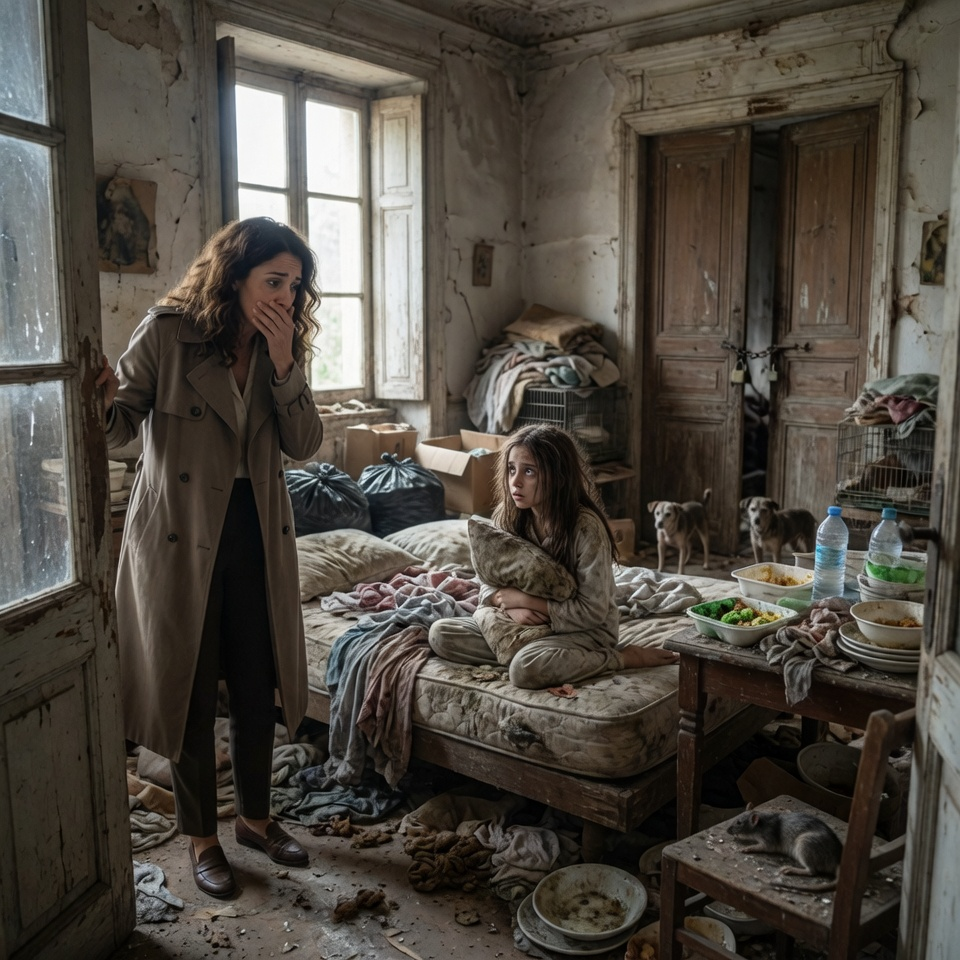
There were garbage bags piled waist-high, plates of moldy, green food, damp clothes, broken boxes, and animal excrement stuck to the floor. Five rooms were unusable, so the three of them slept in a single room. Sofia’s hair was so matted that a plaque had formed against her scalp. Emiliano, who had a developmental delay and needed academic support, hadn’t received any therapy for months.
I tried everything.
I paid a cleaning company. I hired a truck to move furniture. My mother bought beds, clothes, groceries, and even a used refrigerator. Claudia sat at the table, vaping and looking at her phone, saying that it was all too much for her.
Two weeks later, the house was worse.
Then two dogs died. Claudia said it was “sudden.” A friend of hers, Yadira, confessed to me that the bodies remained for several days inside a locked room. The other animals lived in cages inside a bathroom without natural light.
That morning, while I was trying to listen to a lecture at the university, the school called me. Claudia had signed an agreement to bring the children at 7:15. They hadn’t shown up in four days. If this continued, they would initiate proceedings for educational neglect.
I called my mother.
“We can’t keep giving him money,” I told him. “This isn’t just a bad patch. The children are in danger.”
My mother cried, but my father was cold.
—We’ve already done too much. Don’t get involved or you’ll end up destroying your own family.
I had two young children, a partner who looked after them while I studied and worked, and a barely adequate house. Welcoming Sofía and Emiliano would change everything. Even so, when the DIF worker asked me if I was willing to take care of them, I said yes.
That night I sent photographs: the refrigerator covered in mold, a loaded pellet gun lying next to a mattress, the cages, the bathroom, the dead rats found behind an armchair.
Then Yadira called me crying.
“What did you do?” Claudia is beside herself. She says someone reported her and that they’re going to inspect the house tomorrow.
Before I could answer, I heard Claudia shout in the background:
“If they come, I won’t open the door! And my children won’t leave here, not even if they’re dead!”
I couldn’t believe what was about to happen…
PART 2
The next morning we buried our grandmother.
Claudia didn’t arrive.
Our grandmother was the last person I could still hear. Even in the hospital, before she died, she took my hand and said:
—Don’t be so hard on your sister. She’s sick.
Those words haunted me throughout the funeral. While everyone was praying, I thought about Sofia untangling her hair with her fingers and Emiliano asking me how many days were in a month because no one had ever taught him.
Yadira wasn’t at the cemetery either. She had driven almost two hours to Claudia’s house to “help her with the inspection.”
When I arrived, I saw a dumpster full of black bags parked outside. Yadira had spent the night removing trash, cleaning the kitchen, and covering the doors of the most damaged rooms with furniture.
“You’re hiding evidence,” I told him.
“I’m saving her children,” she replied, exhausted. “If they take them away, Claudia will kill herself.”
—Children cannot be held responsible for their mother’s mental health.
Yadira lowered her gaze, but continued mopping.
The DIF worker arrived two hours later. Claudia only allowed her to see the kitchen, the freshly cleaned bathroom, and the bedroom that Yadira had cleared out. When the official asked about the other rooms, Claudia said they were locked because she kept her late husband’s belongings there.
They did not require her to open them.
I called immediately to explain that there were dead animals and trash behind those gates. They told me that without a court order and without “imminent visible danger,” they couldn’t force entry.
I felt like the world was breaking apart.
During the following weeks, the school began making daily calls. The principal came in person several times. Claudia was asleep when they knocked on the door. Yadira took the children to school for three days, but then she had to return to work. Claudia dropped them off at home again.
I called every day.
She also offered to pick them up, give them breakfast, and take them to another school. Claudia didn’t respond. She only spoke to me again when she wanted to borrow my car.
“I need it for work,” she said, as if nothing had happened.
—I’ll take you, but the car won’t leave my house.
—You’ve always been selfish.
Two years later, nothing had improved. It had gotten worse.
Claudia lost her house to debt and then an apartment. She moved with the children and her new boyfriend, Kevin, 22, to cheap hotel rooms or their car. She was almost 40. He used drugs, was in and out of jail, and had a history of violence.
Yadira began to worry about the way Kevin was treating Sofia, who was already 11 years old. She said he would try to be alone with her and would cuddle too closely in the car. When she tried to confront Claudia, my sister accused her of being jealous.
After a fight, Yadira kicked them out of her house and blocked Claudia.
That same week I received a call from the hospital.
Sofia had arrived at the emergency room because she could no longer walk.
She was severely dehydrated, malnourished, and had atrophied muscles after spending months almost immobile inside the car. Doctors suspected a functional neurological disorder brought on by extreme stress.
During the care meeting, a nurse placed on the table an object that had fallen from Sofia’s backpack: a pepper spray can.
“Her mother’s boyfriend says he gave it to her as a sensory toy,” explained the pale nurse.
I looked at Claudia. She didn’t seem embarrassed. She seemed annoyed that she was being questioned.
Then Sofia, who until that moment had not said a word, looked up at me.
“Auntie,” she whispered, “I don’t want to go back in the car.”
The social worker closed the door to the room and placed a recorder on the table.
“We need you to tell us the whole truth,” he said.
Claudia stood up abruptly.
—My daughter will not speak without me.
But Sofia squeezed my hand and replied with something that left everyone speechless:
—Mom knows what Kevin does when she falls asleep.
And just before she could explain what she meant, Claudia tried to drag her out of bed.
PART 3
Two nurses intervened before Claudia could touch Sofia.
My sister screamed that we were all conspiring against her, that I’d been trying to steal her children for years, and that the doctors were exaggerating to justify their salaries. Kevin, who was waiting outside, banged on the door and demanded to be let in. Security escorted him out of the apartment.
For the first time in a long time, an institution did not accept his excuses.
The hospital social worker notified the prosecutor’s office and the Child Protection Agency. An officer stayed with Sofía while Claudia was taken to another room. I stayed by the bed, feeling like the girl was crushing my fingers.
“You don’t have to say anything you don’t want to,” I told him.
“Yes, I want to,” she replied. “But if I talk, my mom will be left all alone.”
That sentence broke me.
Sofia wasn’t worried about herself. She was protecting the person she had allowed to live sick, out of school, and in fear. For years, Claudia had repeatedly told her that if anyone found out how they lived, they would be separated and she would die. She had taught them that asking for help was a betrayal.
The specialist explained that none of what had happened was her fault. Then, in short sentences and with many pauses, Sofía recounted how Kevin would lie down next to her in the car, take her phone, and tell her not to wake his mother. She didn’t describe sexual assault, but she did describe inappropriate physical contact, threats, and behaviors that were enough to open a criminal investigation.
He also confessed that Claudia had witnessed some of that behavior.
“I told him it made me uncomfortable,” she whispered. “He replied that Kevin was just being affectionate.”
When confronted, Claudia changed her story three times. First, she said Sofía was lying because of stress. Then she claimed I had put ideas in her head. Finally, she admitted she had noticed “too much familiarity,” but that she couldn’t kick Kevin out because he helped pay for the hotels.
The truth was worse than she imagined: Claudia had decided to ignore the danger because she depended on Kevin to pay for hotels and drive during deliveries.
That night, the duty judge issued an emergency protection order. Kevin was prohibited from approaching Sofia or Emiliano. Claudia temporarily lost custody while her ability to care for them was evaluated.
When the official asked me again if I was willing to receive them, I looked at my partner, Daniel.
He was terrified. So was I.
We had two small children, little space, and impossible schedules. Even so, Daniel took my hand.
“We can’t promise it will be easy,” he said. “But we can promise you’ll be safe.”
We accept.
Emiliano arrived that morning with a backpack, an old game console, and the same clothes he’d been wearing for the past four days. He was 16 years old, weighed over 130 kilos, suffered from hypertension and high cholesterol, and could barely climb the stairs without getting winded. When I showed him his room, he stood frozen in the doorway.
—Is all this for me?
It was a small room: a clean bed, a used desk, a lamp, and an empty closet. Nothing extraordinary.
—Yes. Nobody is going to store trash here. Nobody will enter without knocking.
Emiliano closed the door and cried silently.
Sofia spent three weeks in the hospital and began physical rehabilitation and therapy. At first, she hid bread under her pillow and water bottles in the bathroom.
The first time Daniel found the food, he didn’t scold her.
She put a transparent box in her room with cookies, fruit, and water.
“This is yours,” he told her. “It will be refilled every week. You don’t need to hide it.”
Sofia looked at him as if he had spoken to her in another language.
Emiliano faced a different kind of pain. He had gone more than two years without a real education. Claudia said she was homeschooling him, but there were no books, schedules, or homework. At 16, he had huge gaps in reading, math, and basic knowledge.
When a teacher asked her how many days were in February, she lowered her head and said:
—I’m an idiot.
“No,” I replied. “You’re a young man who was left without tools by the adults. That can be fixed.”
It wasn’t easy. He would get angry, tear up papers, lock himself in his room, and binge eat. Some nights he would secretly call Claudia. She told him that we wanted to make him “sick” so we could get government money.
Claudia posted on social media that I had kidnapped her children out of envy and that I had made everything up.
But there were records: school absences, welfare reports, hospital diagnoses, missing animal records, and the photographs that Yadira had deleted.
When Yadira was summoned, she tried to downplay what had happened.
“I just wanted to help,” he said.
The judge asked him why he had removed animal carcasses and only cleaned the areas that the social worker would see.
Yadira began to cry.
—I thought that if the house looked better, they wouldn’t take the children away.
—And what happened after you helped her avoid the consequences?
Yadira did not respond.
The silence was enough.
That day I understood that making things easier doesn’t always seem cruel. Sometimes it disguises itself as loyalty, compassion, and rescue. But every time we cleaned for Claudia, paid off a debt, or lied to protect her, we showed her that things could stay the same. And those who paid the price were Sofía and Emiliano.
My mother also had to testify. For years she had sent money to the landlord, bought clothes, and paid for hotels. In court, she admitted that she often knew the children weren’t in school, but she was afraid that reporting it would lead to something worse.
“I thought keeping them close to their mother was the most humane thing to do,” she said, crying.
The judge was firm.
—Keeping a child close to their mother is not a benefit when that closeness keeps them sick, isolated, and exposed to danger.
My father didn’t attend. By then, my parents had divorced, and we had all spent years organizing our lives around the chaos of Claudia.
Claudia received a reunification plan: psychiatric evaluation, substance abuse treatment, grief therapy, stable housing, verifiable employment, and parenting classes. She also had to cut off all contact with Kevin.
At first he swore he would do what was necessary.
Two days later she appeared in the hospital parking lot with him.
Security saw them together. Claudia said she was just returning some belongings. Later, police confirmed they were still staying in the same room.
At the next hearing, my sister looked at me with a hatred I will never forget.
“You wanted this,” he told me. “You wanted to keep my children.”
“I wanted you to be their mother,” I replied. “But they couldn’t keep waiting for you to decide to be one.”
Claudia lost custody indefinitely. It wasn’t a victory. Nobody left the courthouse celebrating.
For months, Sofia asked if her mother was eating. Emiliano insisted on saving money to pay for a room for her. They had both learned to feel responsible for her. Therapy consisted, in large part, of teaching them that loving someone doesn’t mean destroying yourself to save them.
There were setbacks. Sofia suffered anxiety attacks at the sound of a car starting and it took her months to allow anyone to cut her tangled hair. When she finally agreed, she looked in the mirror and smiled.
—I look like a normal girl.
I had to go to the bathroom to cry.
Emiliano started a special education program and received medical attention. He didn’t lose weight immediately, nor did he magically become disciplined. First, he had to learn to get up in the morning, bathe, eat on schedule, and tolerate frustration. Six months later, he passed his first math exam with a 7.
He stuck the sheet on the refrigerator.
“I’ve never passed anything before,” he said.
Daniel and I argued about money, space, and exhaustion. We asked for support and agreed to family therapy because love alone wasn’t resolving our traumas.
A year later, Claudia still wasn’t following the plan. She kept changing hotels, making deliveries through apps, and continuing her relationship with Kevin despite the court order. She had also started taking fertility medication because she wanted another baby.
When I found out, I felt such rage that I had to sit down.
The Attorney General’s Office opened a preliminary investigation, and the doctor who prescribed the medication was informed of her situation. They couldn’t prohibit her from getting pregnant, but they could monitor her for any new risks.
Claudia called me that night.
—You took my children away from me and now you want to take away my chance to be a mother again.
—I didn’t take it from you. You lost it every day you chose to sleep, lie, and look the other way.
—Our grandmother was right. You were always a bitch to me.
For the first time, that phrase didn’t make me feel guilty.
—Maybe. But I was the bitch who stopped protecting you and started protecting them.
He hung up.
I don’t know if my sister will ever accept treatment. I don’t know if we’ll ever be friends again. I miss her, but I also understand that the person I missed hasn’t existed for years.
Sofia and Emiliano are still with us. They aren’t “cured,” and our family hasn’t become a perfect story. There are hearings, therapy, doctor’s appointments, overdue homework, and difficult nights. But they go to school. They have friends. They eat at a clean table. They sleep in their own beds. They know they can open the refrigerator and find food.
One afternoon, upon returning from class, Sofia left her backpack at the entrance and said to me:
—A colleague invited me to her birthday party today. Can I go?
It was a simple question. For her, it was a new life.
—Of course you can.
She rushed upstairs to choose clothes. Emiliano called from the kitchen that he could help her. Daniel was serving dinner, and my young children were arguing over glasses. The house was noisy, cramped, and far from perfect.
But she was alive.
For years I believed that reporting my sister was betraying her. Now I know that the real betrayal would have been to remain silent while her children slowly disappeared in front of everyone.
Sometimes, loving someone means reaching out to them.
And other times it means ceasing to uphold the lie that keeps it standing.