PART 1
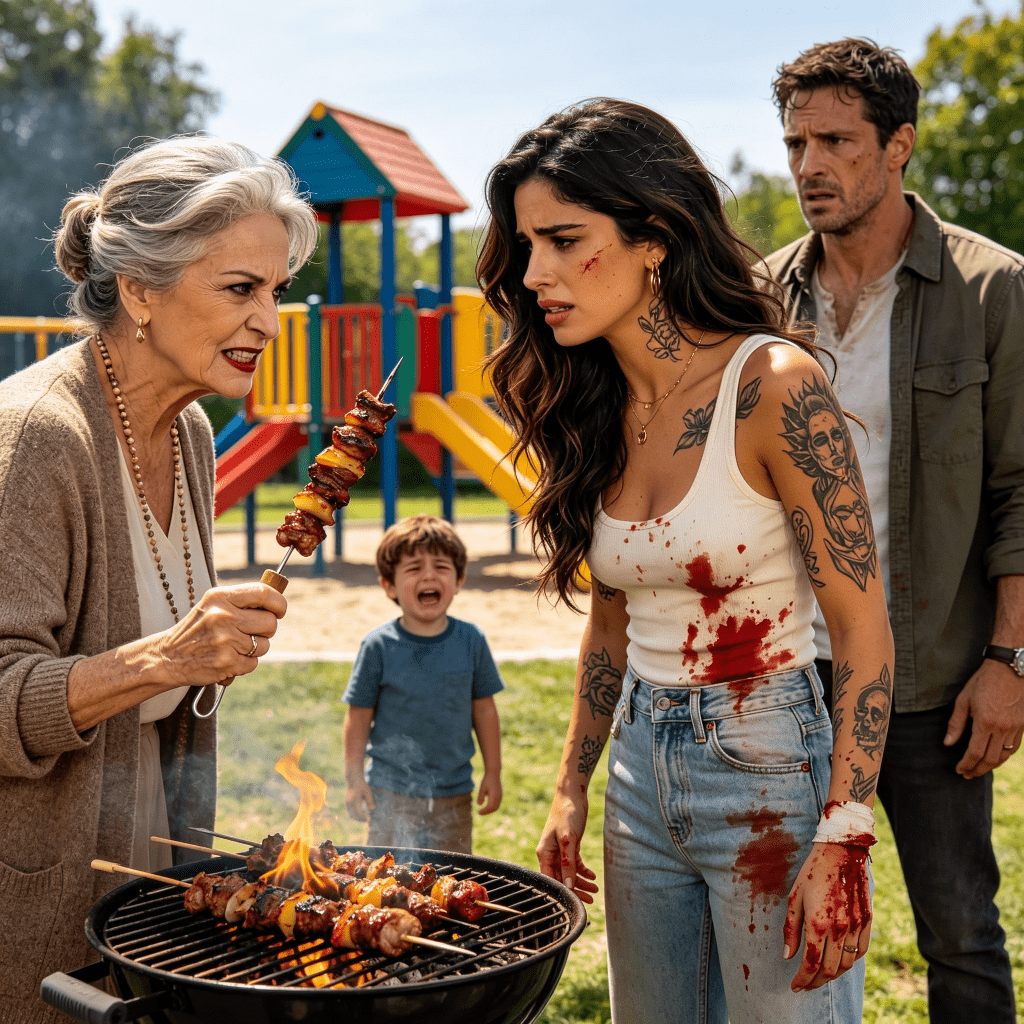
—“If you love those devil tattoos so much, then learn what it feels like to have your flesh pierced,” my mother-in-law spat seconds before plunging a hot iron into my arm.
My name is Mariana, I’m 29 years old, I’m a tattoo artist in Guadalajara, and until that afternoon I thought the worst thing Doña Teresa could do to me was make me pray out loud for God to “cleanse my skin.” I’d been with Daniel for six years, married for four, and we had a three-year-old son, Mateo, a cheerful boy who loved dinosaurs, swings, and the enormous playhouse his grandmother had installed in their backyard.
Doña Teresa never accepted me. At first, she said I was “a good girl, but confused.” Then, when Daniel got his first tattoo with me, she changed. For her, every line of ink on her son’s body was a personal offense, as if I had stolen the child she had raised to become an obedient, clean, and biblical man.
“I gave him that healthy body,” she’d repeat. “And you’re going around scratching it like a dive bar wall?”
Daniel would laugh nervously, squeeze my hand under the table, and then, when we were alone, ask me not to provoke her.
We lived in a house that belonged to Doña Teresa. She charged us cheap rent, too cheap, and for years she used that as a leash. If I denied Mateo anything, she’d go to Daniel. If I didn’t want the boy to eat candy before bed, she’d secretly give him lollipops. If I said he couldn’t stay with her because I’d scolded him badly, Daniel would mutter,
“She’s his grandmother, Mariana. Don’t exaggerate.”
But I had seen things. Once, when Mateo was barely 18 months old, she spanked him so hard it left a handprint. Another time, when my son spilled spaghetti on her dining table, she called him a “useless brat” and made him cry until he threw up.
I should have left then. I should have protected him sooner. But when you live surrounded by subtle abuse, by sweet-voiced blackmail, by “it’s for your own good” and “that’s how we raised them back then,” you start to believe you’re the crazy one.
That Sunday, I only agreed to go to their house because Mateo had been begging to use the playhouse for weeks. Daniel’s stepfather, Don Ramiro, prepared charcoal for grilling meat. Doña Teresa ordered tacos, made hibiscus water, and even spoke to me with a false calm that made me lower my guard.
While Mateo ran around the yard, Don Ramiro showed me a tattoo of an eagle with very fine shading on his cell phone.
“Could you do something like that?” he asked me.
“Yes, but I’d need to practice that style. It’s very delicate work.”
Doña Teresa let out a dry laugh.
“Sure, now you even want to contaminate my husband.”
I, clumsy and tired of bowing my head, replied jokingly:
“Well, being a bad influence comes with the job. I guess that’s why I stab people to make a living.”
I didn’t finish smiling.
Doña Teresa grabbed one of the metal skewers from the fire, one of those long ones for grilling sausages, and swung at me with a speed I’d never seen from her. First I felt the impact, then the burning, then the dirty heat seeping under my skin.
I screamed.
Mateo started crying from the little house. Daniel froze. Don Ramiro snatched the skewer from his wife and dragged her inside, repeating,
“I’m sorry, I’m sorry, please don’t call the police.”
I looked at my arm. The wound wasn’t huge, but it was bleeding and had ash stuck to it. My son was running toward me shouting “Mom,” and Daniel, instead of hugging us, turned toward the door through which his mother had disappeared.
“I’m going to talk to her,” he said.
That night, with my arm burning and Mateo asleep on my chest, Daniel asked me to forgive her.
“My mom didn’t know how strong she was. She says it was a joke.”
“She stabbed me with a piece of iron, Daniel.”
“If you call the police, I’ll never forgive you.”
Then she added the phrase that chilled me more than the wound:
“And if you don’t call them to fix this, I’m taking Mateo with her tonight.”
That’s when I understood that the blow hadn’t ended with my arm. Something I couldn’t believe was going to happen was just beginning…
PART 2
My sister Lucía arrived 15 minutes after my call, her hair wet, keys in hand, and a fury she made no attempt to hide.
“Pack your clothes and Mateo’s. Now.”
Daniel started crying when he saw the suitcases. He begged me not to destroy the family. He told me his mother was devastated, that she felt “like a criminal,” that she had said if everyone saw her as an abuser, she didn’t want to live anymore. Lucía took Mateo and put him in the car before he could hear any more.
I made the mistake of agreeing to speak with Doña Teresa one last time.
She arrived at our house without knocking because she had a copy of the key. The first thing she asked was,
“Where’s my boy?”
“With my sister.”
She pouted, like a spoiled child.
“You wanted to talk, so talk.”
Daniel later confessed that he had told his mother I was exaggerating and that he would probably apologize. That’s why she sat so confidently, legs crossed, like the queen of a house that wasn’t even mine.
I asked her why she had attacked me.
“I didn’t attack you. I just wanted you to understand what you do. You said you prick people. I pricked you. I didn’t know it would bleed.
” “Do you think that’s normal?”
Then she blurted out what she’d been hiding behind prayers for years.
“It’s just that you’re very difficult to deal with, Mariana. I expected a more biblical woman for my son. Not a woman covered in drawings, piercings, and arrogance.”
Daniel, for the first time in years, stood up.
“What does that mean, Mom?”
She looked at him as if he were eight years old.
“That your wife needs discipline. “
And that’s when she gave herself away.
She said that “I hadn’t even gone that deep,” that if she had really meant to hurt me, I’d be in the hospital, that I should be grateful she still considered me family. Daniel went pale. I saw on his face the shock of someone who finally hears the truth, but doesn’t know if he has the courage to stand by it.
“Get out,” he told her.
Doña Teresa screamed, cried, and called her son ungrateful. Daniel pushed her toward the door and closed it.
For a moment, I thought my marriage was saved.
I was wrong.
That morning, Daniel called me from Lucía’s house.
“On second thought, I’m not going to move. My mom offered to let us have the house for free if we just put this behind us.”
I was speechless.
“For free? Is my blood worth the rent?
” “Don’t put it that way.”
Then I reminded him of the scar he left on Mateo when he was a baby, the humiliations, the times he secretly took him to his mother’s house after promising me he wouldn’t. Daniel didn’t deny anything. He just kept repeating,
“She’s my mom. She’s his grandmother. He’s going to see her one way or another.”
At that moment, I decided to file a report.
The next day, with my arm bandaged and a tetanus shot, I went to the Public Prosecutor’s Office with Lucía. I handed over photos, messages, and an audio recording where Doña Teresa admitted that “it was just a joke.” I also captured the message she sent me afterward:
“You can’t take my grandson away from me. If you try, I’ll fight back.”
I filed for divorce.
Daniel went to pick up Mateo from daycare, even though I hadn’t taken him. The teacher called me, terrified. Minutes later, he texted me:
“Tell me where my son is.”
I replied that he could see him, but not take him to his mother.
He didn’t answer.
That night, I understood that I was no longer fighting for a marriage. I was fighting to keep my son from being swallowed by the same darkness that had turned Daniel into a man incapable of defending us.
And the worst came when Doña Teresa showed up in front of the studio where I worked, smiling, with two coffees in her hand, as if nothing had happened…
PART 3
—I brought you your favorite coffee, daughter— Doña Teresa said from the studio doorway, while my fellow tattoo artists stood motionless.
I was setting up a machine, gloves on, my heart pounding in my chest. My boss, Saúl, came out of the cubicle when he heard her voice. Doña Teresa faked a sad smile, the kind people use when they want to appear victimized before attacking.
—I just want to talk. Mariana is confused. My grandson needs his family.
—You can’t be here— I said.
—Don’t be ridiculous. I didn’t come here to fight. I came to save what’s left.
Saúl stood in front of her.
—Ma’am, get out of my shop or I’ll call the police.
Her face changed. The mask fell off like glass.
—Because of women like you, men abandon their mothers!— she yelled at me. —You covered my son’s skin with filth and now you want to turn him against me!
I asked Saúl to call security. She left before they arrived, but that afternoon she sent me 17 messages. In one, she said I was “possessed by my ego.” In another, that Mateo would one day hate me for separating him from his Nana. In the last one, she wrote:
“If the law doesn’t understand a grandmother’s love, I’m going to teach it.”
My lawyer, Attorney Paredes, read everything silently.
“Mariana, this isn’t just an intense mother-in-law anymore. This is harassment. And with the history of violence against you and the child, we’re going to request emergency custody.”
I moved in with my aunt Yolanda, on the south side of the city. My mother took vacation time to help me. Mateo slept hugging a stuffed dinosaur and asked every night,
“Is Daddy coming for me?”
I told him that Daddy was taking care of grown-up things, that it wasn’t his fault, that Mommy loved him and that he was safe. But every time I saw him looking at the door, something inside me broke.
A week later, Daniel arrived at my aunt’s house.
He didn’t knock like a normal person. He pushed against the gate, yelled my name, and demanded to see Mateo. My aunt tried to close the door, but he pushed it so hard it fell against the wall. My mom ran upstairs with Mateo. I went out into the hallway and saw Daniel banging on the door of the room where my son was crying.
“Mateo, come out! I’m your dad!
” “Or what?” my mom yelled from inside. “Are you going to break the door? Are you going to let your mother take him?”
I pushed him away. Daniel pushed me back. It wasn’t a small push. It was with rage, with all the rage I used to hide behind excuses. I ran downstairs and locked myself in the bathroom. He banged on the door with his shoulder, hurling insults at me, while Mateo screamed upstairs.
Doña Teresa had come with him. I saw her through the crack in the window, going into the living room and putting Mateo’s toys into bags, as if she were rescuing her own belongings.
The police arrived because my aunt managed to call from the car.
Daniel was arrested for trespassing and assault. Doña Teresa tried to explain that she was only “collecting the boy’s things to take him to a safe place.” An officer told her that sounded a lot like attempted abduction.
That phrase haunted me for days.
We were granted emergency custody. Doña Teresa was placed under a restraining order prohibiting her from contacting Mateo. From jail, Daniel first said he wanted to see him. Then he said he didn’t. Later, he sent a message through his lawyer saying he would accept minimal visits if I didn’t ask for child support. My lawyer laughed humorlessly.
“Children aren’t like furniture to be traded.”
But the most despicable truth came out weeks later.
Daniel had been cheating on me with a coworker even before the attack. While I was trying to get him to set boundaries with his mother, he was already making plans with another woman. He asked for my “blessing” to live with her when he got out.
I read it three times, hoping to feel something other than exhaustion.
It hurt, yes. But not as I imagined. It hurt because of the part of me that still hoped he would wake up, become a husband, choose his son over the guilt his mother had instilled in him since childhood. It hurt to accept that I hadn’t lost a healthy marriage; I had escaped a burning house.
Doña Teresa didn’t accept the order.
One afternoon she appeared at the supermarket, in the Christmas decorations aisle. Mateo was sitting in the shopping cart, choosing colorful ornaments. I turned for a second to ask for help and heard my son shout:
“Nana!”
She came running with open arms, dressed in red, disheveled, with swollen eyes.
“My boy! Come to Nana! I have presents for you for dinner!”
Mateo stretched his arms out toward her. I hugged him and stepped back.
“Don’t come near me.”
“You can’t do this,” she hissed. “He loves me.”
“Stay away from us.
” Then, in front of entire families, employees, and children, she yelled,
“You stupid bitch! You’re stealing the only family he knows!”
The aisle fell silent. Mateo started crying, burying his face in my neck.
“Mom, let’s go.”
A manager escorted us to the register and then to the parking lot. Doña Teresa was recording us from her car. That night I filed another report. The store initially refused to hand over the video footage, but my lawyer pressed them.
The next breakdown came with an absurd lie.
Doña Teresa wrote to my sister pretending her lawyer was demanding a weekly photo of Mateo with the date clearly visible, “to prove I hadn’t taken him out of state.” She threatened to issue an Amber Alert if we didn’t comply. My lawyer checked the email: no lawyer had sent it. Doña Teresa had impersonated a legal representative.
When the police went to warn her, she pretended not to know anything. Hours later, drunk, she locked herself in a bathroom and threatened to kill herself if Mateo wasn’t brought to her. Her own sister called 911. She was detained for evaluation and, upon release, received a stricter order.
I thought that would be the end of it.
But obsessive people don’t stop because the law speaks to them. They stop when the law slams the door in their face.
The day after Christmas, I found gift boxes on my aunt’s porch. All addressed to Mateo. Inside were toys, clothes, and a note that read:
“If you ever need anything, my child, you know where your real home is. Nana will always rescue you.”
We checked the security cameras. It wasn’t Doña Teresa who left the boxes, but her sister. The police questioned her, and she confessed that she did it on orders because “the order said Teresa couldn’t come near, not that she couldn’t send gifts.”
Doña Teresa was arrested for violating the order.
She paid bail.
She was arrested again a month later.
I had agreed to go out to dinner with a longtime friend. Nothing serious, just a way to remind myself that I was still alive and free from fear. As we said goodbye in the parking lot, he kissed me on the cheek. When I got into my car, I saw Doña Teresa running from a pickup truck. She banged on my window, kicked the door, and yelled that she had caught me “in adultery.” I called the police without rolling down my window.
When they searched her car, they found a notebook.
I had my study schedule, the days my aunt took Mateo to therapy, the name of his school, the recess time, and a drawing of the playground with an arrow pointing to the side fence.
There, even the officer who had previously spoken in a weary tone became serious.
“Ma’am,” he said, “this isn’t just a nagging grandmother anymore. This is planning.”
Doña Teresa yelled that I was a bad mother, that Mateo needed to grow up “without ink, without sin, and without lies,” that if her son was weak, she would do what she had to do. They arrested her again. This time it wasn’t so easy.
When Daniel was informed, he only replied,
“Keep me out of this.”
That was the last sentence I needed from him.
The divorce went ahead. He accepted my terms, including alimony, though he barely requested any visits. His girlfriend was waiting for him outside the courthouse the day he signed. Doña Teresa couldn’t come near. My mother was by my side. My aunt was holding Mateo’s hand. I was wearing short sleeves for the first time since the attack. The scar on my arm was small but visible, a pale line over a flower tattoo I had done myself afterward, around the wound, not to cover it up, but to remind myself that something can grow even where they tried to break you.
Mateo started therapy. At first, he asked a lot about his dad and the playhouse. Then he started talking less about Nana. One day he drew our new house: my aunt in the kitchen, my mother with a shopping bag, me with my tattoo machines, and him in the yard with a green dinosaur.
“And Dad?” the therapist asked carefully.
Mateo looked at the drawing.
“Dad’s far away because he gets angry. But Mom stays.”
I cried in the car, without him seeing me.
Months later, I opened my own small studio in Tlaquepaque. I called it “Flor de Fuego” (Flower of Fire). Not because I wanted revenge, but because the fire that afternoon almost destroyed me, and yet, I ended up using its ashes to start another life.
People on social media had all sorts of opinions when the story got out through family members: that I exaggerated, that a grandmother also has rights, that a wife should endure for her family, that tattoos attract trouble, that I should have forgiven.
But no one saw my son trembling against my neck in that supermarket. No one saw my arm with ash inside the wound. No one heard my husband say he was going to take our son with the woman who had attacked me. No one found that notebook with the schedule of a 4-year-old boy.
So I learned something no woman should have to learn while bleeding:
Family isn’t always the one who shares your last name. Sometimes family is the one who arrives in 15 minutes with the car running. The one who lends you their living room. The one who stands in front of a door so they don’t take your child. Who believes you before you have a folder full of evidence?
Doña Teresa said I had branded her son forever with ink.
She was right about one thing: brands change people.
But the brand that changed me wasn’t a tattoo. It was a wound.
And thanks to that wound, I finally stopped asking permission to save my son.